Author: Support

New Tax Thresholds in 2024 Budget

New Tax Thresholds in 2024 Budget

The New Zealand government has unveiled its 2024 Budget with a core election promise delivered regarding tax relief of $2.57b through bracket adjustments.

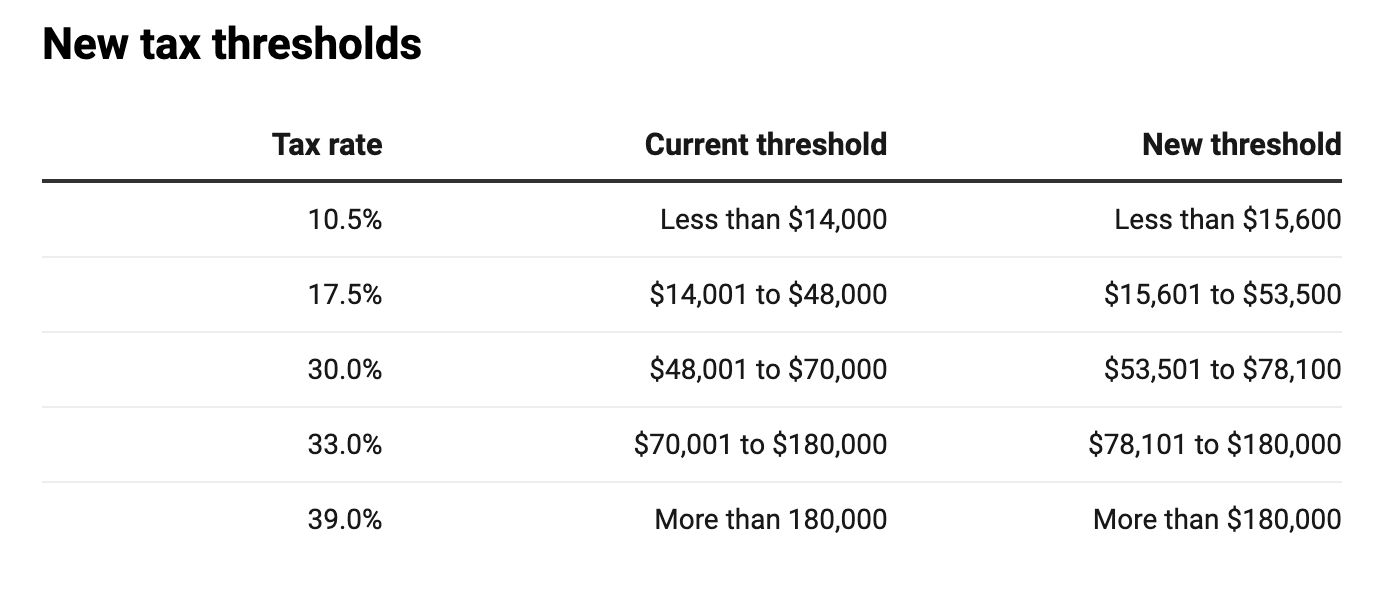
With an adjustment to income brackets, tax rates remain the same but the thresholds are raised.

The Budget stated that 1.9 million households would benefit from the overall relief package by an average of $30 a week. Households with children would benefit by $39 a week on average.

The Independent Earner Tax Credit is being expanded, with the upper limit for eligibility rising from an income of $48,000 to $70,000, with amounts reducing from $66,000+ instead of $44,000+.

A minimum wage worker could expect about $12.50 a week, while superannuitants would take home just $4.50 a week.

National campaigned on enacting these changes at 1 July, but the start date has been pushed back four weeks after advice from Inland Revenue to allow payroll providers more time.

The in-work tax credit will also go up by up to $25 a week from 31 July. National had campaigned on that kicking in from 1 April.The relief package also includes a childcare payment for low-and-middle-income households as already announced.

New Tax Thresholds

Other key government expenditure items in the budget include:

  • $155m on Independent Earner Tax Credit eligibility changes in line with National’s election campaign
  • $182m on In-Work Working For Families Tax credit by $25 a week, in line with National’s election campaign
  • $729m on restoring interest deductibility for residential rental property
  • $45m on adjusting the Brightline Test


Contact Us


What policy changes might affect your business?

What policy changes might affect your business?

Simple Strategies Newsletter | April 2024

Here are some of the changes businesses should watch for:


1. Reintroduction of 90-day employment trial periods

The government has extended the availability of 90-day employment trial periods for all businesses, reversing changes made in 2018, which scrapped 90-day trials for businesses with more than 20 employees.


2. Fair Pay Agreements cancelled

The Fair Pay Agreements Bill has been repealed. Collective agreements can still be negotiated by unions through collective bargaining, however with the repeal of the Fair Payments Agreements Bill, any person or organisation that obtained personal information for the purpose of Fair Pay Agreement bargaining must now dispose of that information in line with the Privacy Act 2020.


3. Fuel tax changes

The Auckland Regional Fuel Tax, adding 11.5 cents to every litre of petrol sold in the city, will end on 30 June 2024. National has also cancelled the previous Government’s planned fuel tax increases that would have added a further 12 cents to the litre. However, the gradual price increase will be replaced in the first year of the next term of Parliament when fuel taxes will rise by 12 cents in one go. After this hike in January 2027, fuel taxes will increase by 6 cents a litre in 2028 and four cents a litre each year after that, meaning by the end of the next term, the Government will have raised fuel taxes by 22 cents a litre. An equivalent increase in road user charges will also occur.

Vehicle registrations will also jump by $50.


4. Minimum Wage Changes 

The government has announced an increase to the minimum wage that kicks in from April 1. The adult minimum wage will rise by $0.45 an hour, taking it up to $23.15 an hour. Starting-out rates and the training wage continue to be at 80% of the minimum wage, $18.52 per hour.

Employers who pay their employees by the day, week, or fortnight need to make sure workers are paid at least the minimum wage appropriate to the basis on which they are paid. Time over an 8-hour day, or 40-hour week or 80-hour fortnight (as applicable) must be paid at least $23.15 per hour.


5. Interest Deductibility Changes

As of 10 March, the coalition government has confirmed the return of interest deductibility for property investors, with the phased-in changes taking effect from the next financial year.

As a result, legislation is expected to be passed allowing you to deduct 80% of your interest expenses on property investments in the year to 31 March 2025 (ie from 1 April 2024). Note that the previously proposed 60% allowance for the current year has been removed, the existing 50% allowance will remain for the current 2023-24 year.


6. Rural regulations set to go

National and Act have committed to reducing regulation and red tape in the farming sector, though it’s not certain yet what that looks like.


We’ll keep you posted.


Contact Us

Tax planning helps you do more with your money

Tax planning helps you do more with your money

Tax planning is a strategic approach to managing your business’ financial affairs, with the aim of legally minimising your tax liability. In other words, you plan ahead to make sure you pay the taxes you should be paying, but not a penny more.

Working with your tax adviser, you can look for deductions, credits, exemptions and tax-saving strategies that will help to optimise your company’s overall tax position.


How does tax planning affect your business?

The primary goal of tax planning is to reduce the amount of taxes your business owes. But it’s also about making sure you stay compliant with all the tax laws and regulations applicable to your business.

But what are the main advantages? Let’s take a look at five of the big benefits of careful, strategic tax planning.

By planning your tax across the year, you can:

  1. Maximise your profits – strategic tax planning helps your company find the best available tax incentives, deductions and credits. This reduces your overall tax liability, cuts your annual tax costs and increases your overall profitability as a business.
  2. Boost your cashflow – tax planning is a great way to open up more liquid cash and achieve a better cashflow position for the business. When you cut down the company’s tax payments, that frees up cash and helps you achieve a positive cashflow position.
  3. Stay compliant and mitigate your risk – being proactive with your tax planning keeps the company compliant with the relevant tax laws and regulations. It’s a sensible way to tick the compliance boxes and reduce the risk of costly penalties and legal issues.
  4. Drive your strategic growth – smart use of tax planning helps you reduce your tax costs and reassign those funds to your strategic business goals. It’s a golden opportunity to invest in areas that promote long-term growth and competitiveness.
  5. Give your business a competitive edge – if managed well, efficient tax planning leads to lower operational costs for the business. This gives you a competitive edge when it comes to pricing, innovation, sales and revenue generation.


How can our firm help you with tax planning?

Getting strategic with your tax planning has many advantages for your financial stability as a business. But to maximise your planning, it’s important to work with an experienced adviser.

As your tax adviser, we’ll help you look ahead across the whole financial year, looking for the opportunities to reduce your tax liability and find the best tax deductions and incentives.

If you’d like to know more about the impact of tax planning, we’ll be happy to explain.

Get in touch to talk about tax planning.


Contact Us

What are your business goals for the year ahead?

What are your business goals for the year ahead?

The beginning of a new calendar year is an excellent time to review the year just finished and reflect on what worked, what didn’t, what you’d like to change and new things you’d like to implement.

Take the time to review the year and acknowledge all that has happened, good, bad or indifferent. Examining the year with an objective perspective can provide valuable insights to prepare for the next business year. Planning and goal setting will help provide a focus for your business efforts.


Your Yearly Business Review

  • What were the most significant impacts on your business in the last 12 months? How well did you meet the challenges?
  • What worked well last year? What systems, technology, products or services were successful?
  • What accomplishments can you celebrate?
  • What situation, event or experience provided the biggest learning opportunity?
  • What is the biggest challenge or frustration you face as you prepare for the year ahead?
  • What did you most enjoy during the year? Do more of it. What did you least enjoy? Do less of it!
  • Analyse your financial reports. Are you earning what you’d like to? Is the business sustainably profitable?


Get Ready for a Great Year

While there are many metrics you could evaluate to track business performance, we’ve given you just a few ideas to inspire your business planning for a positive start to the year.

If you’d like to chat about what you can do differently this year to enable your business to thrive, book a time with us today.


Contact Us

It’s tough at the top (and that’s why you need a business coach)

It’s tough at the top (and that’s why you need a
business coach)

Being a business owner can be immensely rewarding. But it’s also a highly pressurised and stressful vocation to choose. The business journey can be full of pitfalls and challenges that make it more difficult to meet your goals and turn your enterprise into a success.

The good news is that you don’t have to travel this road alone. A business coach is your companion on the journey. A coach will help to shoulder some of the load, so you can get where you’re going faster and with all the personal and business support you might need.


The benefits of working with a business coach

Running a business is a learning experience. Each day will present a new opportunity or challenge, so it’s important to fast-track your learning and build on your own knowledge.

Engaging a business coach is one way to speed up this knowledge and growth process, while also having access to an independent and objective expert in your field. You may be the founder of a new startup, or an experienced entrepreneur with three business ventures under your belt. However experienced you are, it’s helpful to have a sounding board.

A business coach will:

  • Listen to your concerns – when you work with a professional business coach or mentor, this gives you a chance to express your concerns and business challenges openly. A coach will listen and offer guidance without judgement, giving you an independent sounding board to bounce your ideas off and brainstorm new strategies.
  • Know your goals and aspirations – a coach gets to know your goals and aspirations, both professionally and personally. Because of this, they’ll provide tailored advice and support to help you meet these goals and fulfil your long-term vision for the business.
  • Understand the workings of your business – when a coach has a deep understanding of the intricacies of your business, this can be immensely valuable. This knowledge allows them to offer specific insights into your industry, identify potential blind spots and suggest strategies that align with your unique business model.
  • Share their knowledge and expertise – collaborating with a coach or mentor gives you an opportunity to tap into their wealth of knowledge and industry expertise. Their experience helps to provide valuable insights, advice on best practice in your sector and innovative ideas to propel your business forward.
  • Hold you to account and push the envelope – as the boss, there’s not always someone on hand to help you meet your business goals. Your business coach will hold you to account and can challenge you to step out of your comfort zone. They’ll push you to explore new possibilities, set ambitious goals and overcome obstacles, all of which helps you to drive your personal and professional growth as a leader.


Talk to us about our business coaching services

As your accounting adviser, we know your business better than anyone. And we also have the advantage of having worked closely with you to develop and refine your goals as a business leader. We’re perfectly placed to become both your business coach and your close adviser.

If you want to take your professional growth to the next level, we’d love to become your coach.


Contact Us

Plain English guide to cashflow

Plain English guide to cashflow

Why is cashflow so central to good financial management? Here’s our plain English guide.

What is cashflow?

Cashflow refers to the movement of money into and out of your business over a specific period.

In the most basic terms, cashflow is the process of cash moving out of the business (cash outflows), and cash coming into the business (cash inflows). The ideal scenario is to be in a ‘positive cashflow position’. This means that your inflows outweigh your outflows – i.e. that more cash is coming into the business than is going out.

When you’re cashflow positive, the main benefit is that you have the liquid cash available to fund your daily operations and debt payments etc.

On the flip side, if you’re in a negative cashflow position, this can be a red flag that the business is facing some financial challenges – and that some serious cost-cutting and/or revenue generation is needed.


How does cashflow affect your business?

Not having enough liquid cash is one of the biggest reasons for companies failing. So it’s absolutely vital that you keep on top of your company’s cashflow position.


Five key cashflow areas to focus on will include:

  1. Monitoring your cash inflows and outflows – this means regularly tracking your cash inflows from sales, loans and investments, as well as managing your cash outflows from expenses, purchases and debt repayments.
  2. Managing your account receivables and payables – efficiently managing your customer receipts and supplier payments helps smooth out your inflows and outflows – and delivers stable cashflow that’s easier to predict and manage.
  3. Getting proactive with your budgeting and forecasting – creating realistic cashflow budgets and forecasts helps you predict your future cash position. By anticipating your future cash needs, you can actively plan for potential shortfalls or surpluses.
  4. Being in control of your stock inventory – having excess stock in your warehouse ties up cash. So, it’s a good idea to optimise your inventory levels and to only manufacture/order the items you need on a day-to-day basis.
  5. Investing in your cash reserves – with emergency cash reserves in the bank, you know you have the funds to handle unforeseen cashflow issues or sustain your operations during lean periods. This makes your whole cashflow position more stable.


How can we help you with cashflow management?

Positive cashflow is the beating heart of your business. Working with a good adviser helps you keep that cashflow healthy, stable and driving your key goals as a company.

We’ll help you keep accurate records, track your inflows and outflows and deliver the best possible cashflow position for the business.

Get in touch to chat about improving your cashflow.


Contact us

Which business expenses can you claim against tax?

Which business expenses can you claim against tax?

Simple Strategies Newsletter | September 2023

Incurring expenses is an unavoidable fact of running a business. But which expenses can you claim tax deductions against and which don’t meet the tax-free criteria?

Here’s our lowdown on which expenses you can claim against tax.


Which business expenses can you claim deductions against?

If your business expense is directly related to earning your assessable income then you should be able to claim a tax deduction against this particular cost.

For example, everyday business expenses that you may be eligible include:

  • vehicle expenses, transport costs and travel for business purposes
  • rent paid on business premises
  • depreciation on items like computers and office furniture
  • interest on borrowing money for the business
  • some insurance premiums
  • work-related journals and magazines
  • membership of professional associations
  • home office expenses
  • work-related mobile phones and phone bills
  • stationery
  • work uniforms
  • accounting Fees

This is good news for your operational spending, your tax costs and your ongoing cashflow position. The more deductions you can claim, the smaller your tax bill will be. The amount of a deduction (and when you can claim it) will vary, based on the type of expenses you’re claiming. You can find out more on the Inland Revenue Department (IRD) website here.

On the whole though, there are three basic rules for checking the your expense claim is a valid business deduction – and that it won’t be challenged by the IRD.

  1. The expense must have been for your business, available as an allowable deduction and not for private use.
  2. If the expense is for a mix of business and private use, you can only claim the portion that is used for your business.
  3. You must have records to prove that the expense was incurred.


Which business expenses can you NOT claim?

As we’ve explained, you can claim a deduction against most business expenses that are incurred as part of your day-to-day revenue-generation activities. But there are some business expenses you cannot claim against tax.

These non-tax-deductible expenses include:

  • The principal portion of loan repayments.
  • Speeding tickets or parking fines relating to your own or business vehicles.
  • Any penalties you’ve incurred from the IRD relating to late filings or late payments.
  • Purchases of new equipment, machinery or plant, although it’s possible that these assets may be depreciated over time.
  • Insurance premiums for life insurance, accident insurance, personal sickness and mortgage protection insurance.
  • Any costs you’ve incurred in the initial stages of setting up your business.
  • Most clothing, footwear and eyewear is not deductible. But if the clothing is required for the role, i.e. uniforms or safety boots etc, then it may be tax deductible.
  • Legal costs relating to any capital acquisitions you make


Talk to us about reducing your business expenses

This isn’t an exhaustive list of tax-deductible expenses. There will be various ways to claim your operational expenses against the relevant reliefs and incentives offered by the IRD.

If you’re looking to cut back your costs and improve your tax efficiency, we can help. Talk to us about your regular operational expenses and tax costs and we’ll work with you to find the important reliefs, incentives and allowances that can be claimed.


Contact Us

New GST invoice rules – making life easier

New GST invoice rules – making life easier

Simple Strategies Newsletter | April 2023

No more piles of receipts and invoices required!

Dealing with GST invoices is now much simpler. Inland Revenue’s new rules, from 1 April, 2023 aim to modernise your record-keeping systems, which means you’ll be able to get closer to a completely paperless business.

Physical paperwork or PDFs no longer required

From April, you no longer need to keep a physical copy of a tax invoice, a credit note or a debit note. Your taxable information supply can be digital – included in your accounting software, in your transaction records or in contractual information.

New wording – you no longer need to label your invoices as ‘Tax invoice’. The new wording is ‘taxable supply information’, but you don’t need to specify that on any invoices. It’s just the Inland Revenue’s way of explaining that certain information needs to be included on the documentation – you don’t need to make any alterations.

The changes were necessary to make e-invoicing legal, so without any actual paperwork or even a PDF moving around, your system-to-system invoices are still valid.

We’re here to help

If you’re not sure which records you need to keep, just give us a call or drop us a note. We can chat with you about how these changes might impact your business, and how you can use e-invoicing to reduce your risk of invoice fraud. Get in touch!

Contact Us

Key numbers to focus on in your business now

As a business owner, it’s never been more important to have a good grasp on your finances.

For many businesses, priorities have changed, customer behaviours have mutated and revenue streams have had to evolve and pivot in order to maintain a profitable business model.

To track, monitor and drive your financial performance in this updated business environment, it’s increasingly important to have a handle on your key financial reports and metrics.

Getting to grips with your financial reports

Whereas in the past, extra cash in the business may have been seen as a surplus that needed to be spent on something, recent years have shown us that having reserves is vitally important for the survival and long-term health of your business.

To truly be in control of this cash, it’s vital that you can dip into your accounts, financial reports and dashboards and ‘see the genuine story’ behind your financial position.

Here are the key reports to focus on:

  • Budget – your budget is the financial plan that’s tied to your strategic plan. In essence, the budget is your approximation of the money it will take to attain your key strategic goals, and the revenue (income) and profits you hope to make during this period. It’s a benchmark you can use to measure your actuals (historic numbers) against, allowing you to see the variances, gaps and missed targets over a given period.
  • Cashflow Statement – a cashflow statement shows the flow of money into and out of your business. Understanding these cash inflows and outflows in detail allows you to manage this ongoing process, allowing you to aim for a ‘positive cashflow position’ – where inflows outweigh outflows. In this ideal positive scenario, you have enough liquid cash in the business to cover your costs, fund your operations and generate a profit.
  • Cashflow Forecast – forecasting allows you to take your historic cash numbers and project them forward in time. As such, you can see where the cashflow holes may appear weeks, or even months, in advance – and that gives you time to take action, whether it’s increasing your income stream, reducing your underlying costs, chasing up unpaid invoices (aged debt) or going to lenders for additional funding.
  • Balance Sheet – the balance sheet shows you the company’s assets, liabilities and equity at a given point in time. In a nutshell, it’s a snapshot of what the business owns (your assets), what you owe to other people (your liabilities) and what money and profits you currently have invested in the company (your equity). The balance sheet is useful for seeing what stock and equipment the business owns, how much debt (liabilities) you’ve worked up and what the company is actually worth – all incredibly useful information to have at your fingertips when making big business decisions.
  • Profit & Loss – your profit and loss report (P&L) gives you an overview of the company’s revenues, costs and expenses over a given historic period of time. While the balance sheet is a snapshot, your P&L is more like a moving video. It shows you how your finances are progressing by demonstrating how revenue is coming in and costs/expenses are going out (rather than cash coming in and going out, as you see in your cashflow statement and cashflow forecasts).

Talk to us about accounting and financial reporting for your business


We’ll run you through the key reports in your accounting software, and can help you track performance, take action and position your company for growth.

What is the difference between cashflow and profit?

Cashflow and profit are two of the most important financial metrics for any business. But while they’re both related to the financial performance of a company, they measure different things.

Knowing the difference – and how cash and profit contribute to your success story – is a vital skill if you want your business to have the best possible financial health.

The difference between cashflow and profit

Understanding the technicalities of financial reporting can be daunting as a new entrepreneur. And even seasoned business owners can find it hard work resonating with the various financial reports that today’s cloud accounting software can produce.

But getting your head around the differences between cashflow and profit can be a gamechanger – especially when it comes to managing your working capital.

So, let’s look at the differences:

  • Profit refers to the amount of money your business has left after subtracting all expenses from your revenue. It’s a measure of your company’s financial success over a given period, whether that’s a month, quarter or a full 12-months.
  • Cashflow is a process that measures the inflow and outflow of cash in your business. This includes both your operating and investment activities. Maintaining a ‘positive cashflow position’ is vital for meeting your financial obligations.

Why is it important to make a profit?

Profit is a measure of the financial success of your business. It’s also a key factor in your growth as an organisation. Healthy profits mean you have the surplus cash needed to reinvest in the business, and to pay yourself and your fellow shareholders healthy dividends.

However, you can only make a profit if you have enough liquid cash to keep operating – and this is where the importance of cashflow becomes paramount.

Why is positive cashflow so essential?

Poor cashflow is one of the biggest factors in most business failures. As the lifeblood of the company, cash is an essential ingredient in the financial mix. To operate effectively, you need more cash inflows than cash outflows. If not, you don’t have the cash to purchase raw materials, pay your workforce or buy the services that keep you operating.

Positive cashflow is all about ensuring that there’s more cash coming in than expenses going out. In this harmonious place of being in a ‘positive cashflow position’ you have liquid cash available exactly when you need it – and that’s vital for keeping the lights on in the business.

Talk to us about getting in control of your cashflow

Profit is an excellent measure of your financial success. But positive cashflow is the electricity that powers your business and keeps the wheels turning day in, day out.

Positive cashflow helps you:

  • Stay operational, with enough cash in the kitty
  • Meet your financial obligations as a company
  • Invest in your expansion, growth and scale-up strategy
  • Sustain your long-term success as an ambitious business.

Even a profitable business can face liquidity issues, so getting in control of your cashflow really should be top of your financial to-do list this year.

Get in touch to talk about your cashflow position.